
The conversations at this year’s FOWT conference made one thing clear: Risks during operation have to be completely unveiled for an efficient financing and realisation of future floating wind farm. One of the most effective measures to de-risk operation is the implementation of detailed, continuous monitoring. Rather than waiting for periodic ROV inspections that reveal only obvious damage after the fact, operators now have at their disposal a proven continuous virtual mooring load monitoring, anomaly detection informed by a live physics model, and the ability to understand whether observed behaviour reflects genuine structural change or a sensor artefact, without sending anyone into the water. Robust monitoring allows the operators to verify if design assumptions hold true in harsh marine environments and paves the way for predictive maintenance, ultimately driving down OPEX.
However, one critical component consistently presents immense monitoring challenges: the station keeping system. Subsea sensors designed to monitor mooring line tensions are notoriously expensive to procure and highly maintenance-intensive to operate over a project’s lifespan. Yet, without direct measurements, accurately tracking mooring tensions has historically been incredibly difficult.
To address this specific gap, we are leveraging the power of digital twins. After successfully proving the concept in simulated environments, we demonstrated that our digital twin solution has now been validated in a real-world application on the TetraSpar demonstrator.
The TetraSpar Innovation Challenge
The TetraSpar Demonstrator is a 3.6 MW floating offshore wind turbine project commissioned in 2021 off the coast of Norway. The floater features a tubular steel platform, a suspended counterweight, and a 3×1 hybrid mooring system anchored at a water depth of 200 meters.
When the TetraSpar consortium launched an Innovation Challenge calling for novel FOW solutions, the winners were granted access to the project’s unique operational data. sowento and AMOG were selected to demonstrate our FOWT Digital Twin solution, Ozea, on this cutting-edge FOWT.
Ozea: The Physics-Based Digital Twin Monitoring System
Digital twins are virtual representations of a physical asset, with their internal state continually updated using sensor or inspection data. They typically offer several core functionalities:
- Sensor fusion: Combining data from multiple sensors for higher accuracy and robust system state estimations.
- Model-based filtering: Filtering the sensor signals leveraging knowledge about the system’s behavior.
- Virtual sensing: Inferring unmeasured signals from available sensor data and the model of the system.
Through the combination of these features, the immense challenge of tracking mooring loads without direct, expensive subsea measurements can finally be tackled, providing the basis for a cost-effective monitoring solution necessary for scaling FOW.
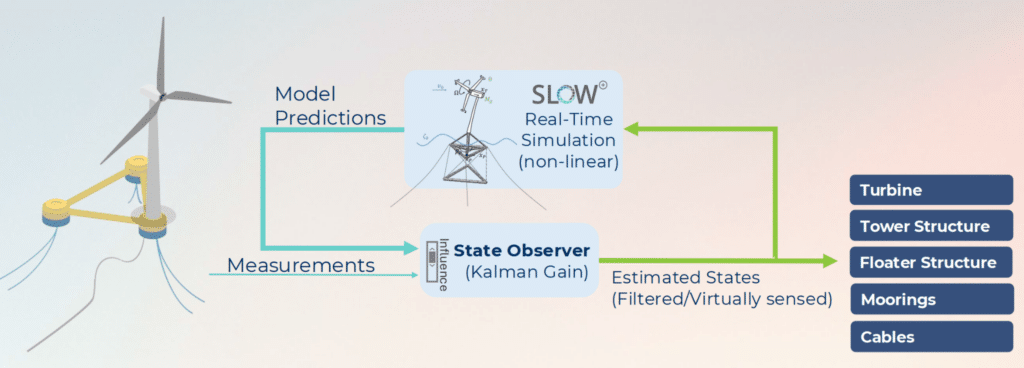
Ozea leverages the concept of the Extended Kalman Filter and uses sowento’s in-house, real-time, physics-based simulation tool SLOW+. By aligning model predictions with available sensor data via a state observer, Ozea is able to estimate all states of the SLOW+ model from the anchors up to the rotor. This process effectively fuses all sensor data in one model, model-based filters the measured signals and virtually senses the unmeasured signals.
Field Validation: Virtual Mooring Sensing in Action
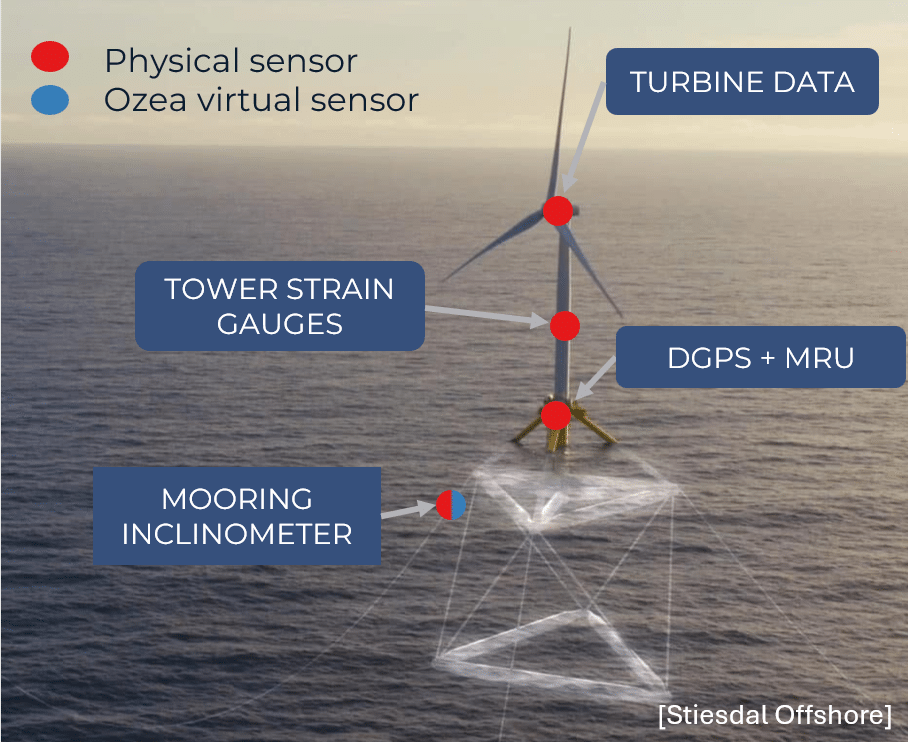
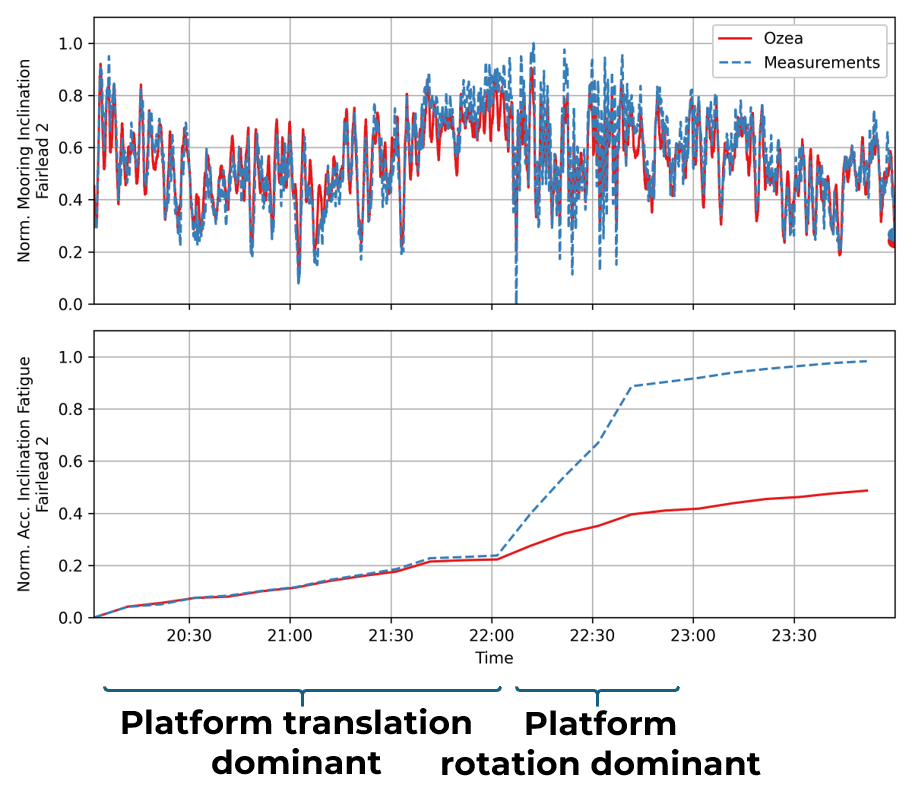
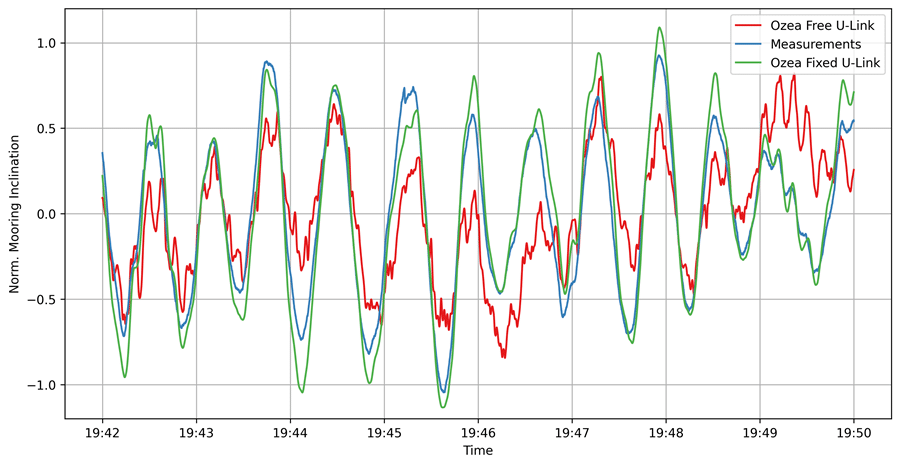
After deploying the digital twin, which involved establishing the data preprocessing pipeline, model construction, and validation, Ozea effectively functioned as a virtual mooring sensor, estimating the mooring tensions. Due to the presence of only an inclination sensor on a TetraSpar mooring line, we converted the inferred mooring tensions into mooring inclinations. This allowed us to compare the virtual sensing results with the actual physical measurements. A strong correlation of actual time series and a fatigue proxy was observed between the digital twin’s predicted mooring angles and the measured physical data, particularly when the platform’s motion was primarily driven by slow translational movements like surge and sway.
Diagnosing Physical Realities with a Physics-Based Digital Twin
One of the most exciting outcomes of the project was how our physics-based digital twin approach helped us understand anomalies in the sensor data. During validation, we noticed a weaker correlation between our virtual sensors and the physical measurements when the platform was dominated by rotational motion, as Ozea did not reproduce the magnitude of the measured inclination amplitudes.
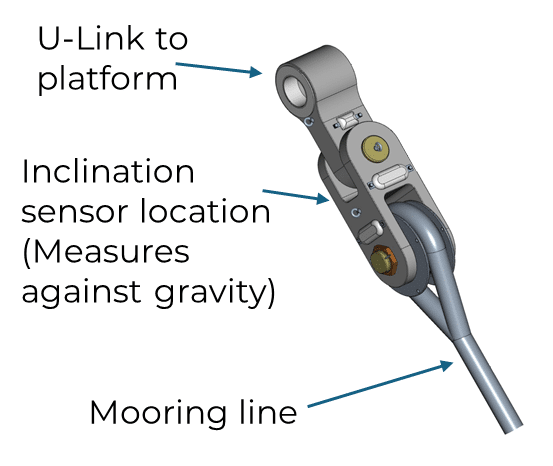
A detailed analysis of the mooring system, facilitated by the digital twin, pointed to friction within the U-Link connecting the mooring line to the platform. We found out that the common “stick-slip” behavior of the U-Link was actually altering the physical inclination measurements because of the sensor’s position above the final bearing. By modeling a simple change – fixing the U-Link angle in the Ozea model – we were able to reproduce the increased oscillation seen in the measurements.
This perfectly highlights the immense value of a physics-based digital twin: The ability to rapidly modify the underlying physics model without the need for time-consuming retraining, a major advantage over purely data-driven methods, enabling detailed analysis for real-world issues.
Conclusion
The deployment of Ozea on the 3.6 MW TetraSpar demonstrator proved that a holistic, physics-based Digital Twin can be successfully implemented at full scale. More importantly, it confirmed that virtual mooring load sensing is highly viable, demonstrating good agreement across static and dynamic loads without the need for delicate, subsea hardware.
Looking ahead, we are excited to push Ozea even further. An upcoming validation project in 2026 will benchmark our virtual mooring sensor directly against physical load-cells. By continuing to publish and refine these virtual sensing capabilities for deformation and loads, we can help the FOW industry confidently scale into commercial farms while keeping risk and OPEX firmly under control.
Further information
To get more information about the technology and our model-based monitoring approach you can visit our website at www.ozea-monitoring.com
